Emergency Roofing Dispatch for Loveland, Historic Downtown, Symmes Township & Miami Township
When severe thunderstorm supercells sweep through the Ohio Valley, homeowners and commercial asset managers across Loveland, Historic Downtown, Symmes Township & Miami Township require immediate, decisive intervention. Architectural configurations in this region frequently feature Historic riverfront properties, hillside parcels nestled in dense deciduous timber, multi-level architectural rooflines, and intricate valley junctions.. These complex geometries enhance curb appeal but create multiple vulnerable transition junctions, valley splits, and flashing intersections that encounter severe hydraulic pressure during concentrated rainfall events.
Roof Expert USA operates a dedicated 24/7 emergency dispatch service connecting Loveland, Historic Downtown, Symmes Township & Miami Township property owners directly with pre-vetted, insured local roofing crews equipped for rapid on-site stabilization. Whether your home has sustained direct hail strikes from convective summer squalls, partial roof decking punctures from fallen hardwood limbs, or wind uplift tearing shingles along nail lines, our referral network provides immediate telephone triage without bureaucratic web forms or delayed call-backs.
1. Regional Microclimate Dynamics & Severe Storm Vulnerability
The microclimate of Clermont, Hamilton & Warren Counties presents severe, distinct seasonal challenges to roofing envelope integrity. Located within the volatile Ohio River Valley weather transition corridor, this sector experiences Little Miami River basin wind vortexes, microclimatic humidity spikes, fallen mature hardwood limbs puncturing roof decking, and intense localized downpours.. During the spring and summer storm seasons, boundary collision between humid Gulf moisture and continental Canadian cold fronts spawns rapid-developing bow echoes and tornadic shear lines capable of tearing dimensional shingles from their starter courses in seconds.
In winter and early spring, the Ohio Valley freeze-thaw oscillation exerts immense stress on roofing substrate assemblies. With ambient temperatures regularly cycling across the 32°F freezing threshold within twelve-hour windows, melted snow trapped behind leaf-choked gutters or ice dams refreezes, expanding within shingle keyways and lifting lap joints. Dispatched local crews utilize specialized thermal imaging and pneumatic sealing systems engineered to counteract these exact microclimatic dynamics.
Localized Microclimate & Repair Protocols for Loveland, Historic Downtown, Symmes Township & Miami Township:
- Interstate Weather Corridor Uplift: Accelerated wind dynamics across regional transportation corridors mandate ASTM D7158 Class H fastener patterns (6-nail per architectural shingle) to resist 130 mph straight-line gusts.
- Mature Tree Canopy Impact: Dense suburban oak and maple foliage increases the probability of heavy deadwood shearing during macrobursts, requiring emergency rigging and rafter sistering capabilities.
- Convective Hail Cell Attenuation: Frequent high-velocity hail swarms necessitate forensic test square chalking to distinguish between mechanical hail fracturing and latent natural shingle weathering.
- Rapid Hydrostatic Valley Overflow: Multi-gable estate rooflines demand 36-inch continuous self-adhering modified bitumen ice and water membranes in all valleys, dormer sidewalls, and chimney saddles.
2. Non-Destructive Moisture Diagnostics & FLIR Thermal Tracing
In complex suburban architecture across Loveland, Historic Downtown, Symmes Township & Miami Township, the visible point of interior water infiltration rarely aligns directly with the exterior roof breach. Water entering through a compromised ridge cap, cracked skylight curb, or lifted shingle tab can travel dozens of feet laterally across angled plywood sheathing and along horizontal ceiling joists before saturating interior drywall or dripping through recessed lighting fixtures.
To prevent destructive exploratory drywall removal, dispatched local specialists deploy advanced non-destructive diagnostic technology, including high-resolution FLIR® (Forward Looking Infrared) thermal imaging cameras and high-frequency non-penetrating dielectric capacitance moisture meters. Because wet insulation and saturated wood sheathing retain thermal energy at a significantly different rate than surrounding dry building materials, infrared thermography displays active moisture pathways as precise thermal anomalies on calibrated color displays.
This diagnostic rigor allows technicians to map the exact boundary of hidden attic moisture, identify saturated fiberglass insulation batting requiring decontamination, and trace the exterior water ingress source with millimeter precision before executing emergency repairs.
3. Step-by-Step Substrate Restoration Methodology
Long-term roof system recovery in Loveland, Historic Downtown, Symmes Township & Miami Township requires systematic engineering protocols rather than superficial surface caulking. Dispatched contractors adhere to an exacting four-phase physical restoration sequence:
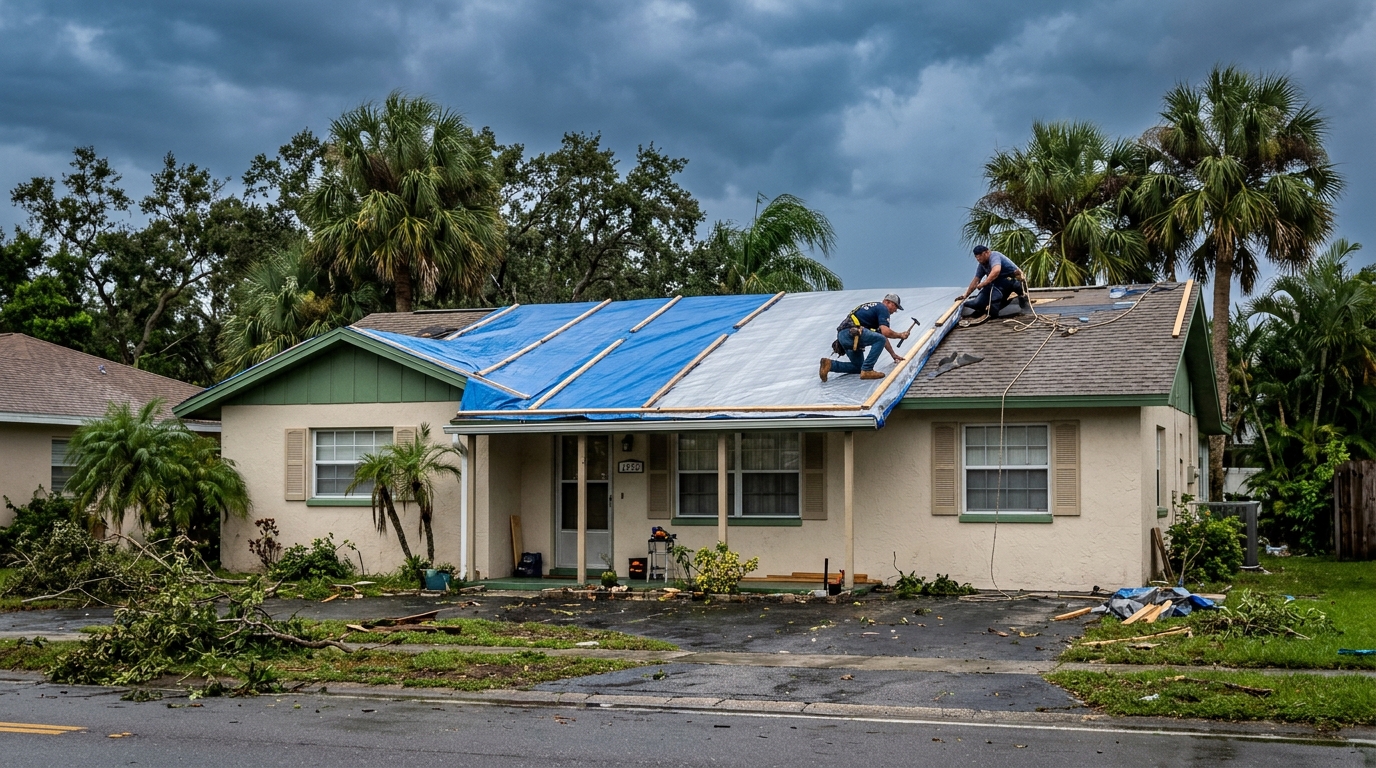
- Phase 1: Immediate Structural Stabilization & Hydraulic Diversion: Upon arrival, the crew secures immediate weather envelope protection. In cases of tree impact or missing shingles, heavy-duty 10-mil woven polyethylene tarps are mechanically anchored over 2x4 kiln-dried lumber furring strips secured into rafter trusses. Interior drywall water blisters are strategically relieved using center-puncture drainage hoses into collection reservoirs to prevent ceiling collapse.
- Phase 2: Substrate Deconstruction & Sheathing Inspection: Compromised surface shingles, damaged underlayment, and delaminated OSB or plywood decking are carefully cut away back to sound structural framing. Rafter trusses are examined for mechanical fractures or moisture rot; compromised members are reinforced with structural sistering using Simpson Strong-Tie hardware.
- Phase 3: High-Performance Underlayment & Flashing Integration: Premium self-adhering SBS rubberized asphalt membrane (ASTM D1970 compliant) is heat-bonded directly to the fresh CDX plywood substrate. Step flashings along brick chimneys, stone dormers, and sidewalls are replaced with 26-gauge galvanized steel or 16-ounce cold-rolled copper, fully integrated behind existing weather-resistive barriers.
- Phase 4: Manufacturer-Specified Shingle Installation & Sealant Application: Color-matched architectural shingles (such as Owens Corning Duration or GAF Timberline HDZ) are installed using 6-nail high-wind mechanical fastening patterns. All exposed reglets and counter-flashing joints are hermetically sealed with premium polyurethane or hybrid polymer architectural sealants meeting ASTM C920 Class 50 specifications.
4. Building Code Compliance & Insurance Documentation in Clermont, Hamilton & Warren Counties
All roofing restoration operations across Loveland, Historic Downtown, Symmes Township & Miami Township must comply strictly with the Ohio Residential Building Code (RCO), local municipal building regulations, and ASTM material manufacturing standards. Under Ohio building standards, re-roofing operations exceeding 25% of the total roof area or structural decking replacements necessitate municipal permits, code-compliant ventilation balancing, and ice-barrier underlayment extending a minimum of 24 inches inside the interior heated wall line.
Furthermore, navigating homeowners insurance claims following severe convective weather requires objective forensic evidence. Dispatched network contractors generate comprehensive digital inspection dossiers, including high-resolution macro photography of hail spatter marks, chalked 100-square-foot test squares, wind creasing documentation, and standardized Xactimate® scope itemization. This meticulous documentation facilitates seamless adjuster reviews and expedites emergency reimbursement.
5. Preventative Property Maintenance & Severe Storm Preparedness
Proactive envelope maintenance is essential to preserving structural roof longevity in Loveland, Historic Downtown, Symmes Township & Miami Township. Property owners should implement the following seasonal risk-reduction measures:
- Hardwood Canopy Clearance: Maintain a minimum 10-foot clearance between overhanging tree branches and the roof surface. Heavy limbs abrade ceramic shingle granules during wind sway and risk catastrophic fracture during convective downdrafts.
- Biannual Eave & Downspout Debris Cleansing: Thoroughly clean gutters and valley discharge points each spring and autumn. Clogged troughs cause storm rainwater to back up underneath drip edges and rot subfascia boards.
- Attic Ventilation & Insulation Balancing: Inspect soffit intake baffles and ridge vents annually to prevent attic heat buildup. Excessive attic thermal retention accelerates shingle blister aging in summer and fuels winter ice damming.
- Post-Weather Visual Surveillance: After any storm producing gusts over 50 mph or quarter-sized hail, conduct ground-level perimeter inspections using binoculars to check for displaced tabs, detached chimney counter-flashing, or gutter granule accumulations.
Need Immediate Storm Damage Dispatch in Loveland, Historic Downtown, Symmes Township & Miami Township?
No contact forms, dispatch voicemail queues, or contractor delays. Speak directly with a live Cincinnati regional dispatch coordinator right now.
CALL LOVELAND, HISTORIC DOWNTOWN, SYMMES TOWNSHIP & MIAMI TOWNSHIP DISPATCH: (888) 208-4155